When I first decided to ditch traditional disposable canned air, I found myself staring at two dominant choices: the Wolfbox MF50 and the Wolfbox MF100.
My primary goal in this breakdown is to analyze how these two electric air dusters perform in real-world scenarios, helping you identify which model delivers the precise airflow, runtime, and accessory package your cleaning tasks require.
By comparing their motor speeds, battery efficiencies, and daily usability, you will easily see which option offers the best value for your setup.
| Feature | Wolfbox MF50 (MegaFlow50) | Wolfbox MF100 (MegaFlow100) |
| Max Motor Speed | 110,000 RPM | 150,000 RPM |
| Maximum Wind Speed | Approximate 30-35 m/s | 45 m/s |
| Weight | 0.45 lb (approx. 200g) | 0.66 lb (approx. 300g) |
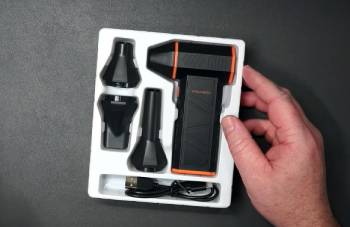
| Included Accessories | 4 interchangeable nozzles | 5 nozzles, 2 brushes, lanyard |
| Maximum Battery Life | Up to 240 minutes (low gear) | Up to 100 minutes (low gear) |
| Charging Time | 3.5 Hours via USB-C | 2.5 Hours via USB-C |
| Build Construction | Durable composite material | Premium all-metal casing |
Understanding Cordless Air Blower Performance
When you transition from standard single-use compressed air cans to a dedicated brushless motor blower, the performance metrics shift completely.
Disposable cans drop in pressure as they freeze during prolonged use, which limits their effectiveness on stubborn grime.
The core technology inside both the MF50 and MF100 relies on high-speed brushless motors that maintain consistent output throughout the battery cycle.
The immediate benefit of a brushless system is the sheer rotational speed, measured in revolutions per minute (RPM).
Higher RPM translates directly to increased kinetic energy in the air column leaving the nozzle. This stream dislodges fine particulate matter that has bonded to surfaces via static electricity or minor moisture oils.
When analyzing these tools, wind velocity is measured in meters per second (m/s). This speed determines how deep the airflow can penetrate dense structures, such as a multi-layered computer radiator or tight vehicle air vents.
A faster velocity strips away debris much more efficiently than a wider, slower volume of air.
The Core Technical Differences
To understand why one model might suit your workspace better than the other, we must examine their raw mechanical specifications.
The MF50 utilizes a highly efficient 110,000 RPM motor. In my testing, this provides more than enough force to clear loose surface debris, desk crumbs, and light household dust.
It operates quietly and generates minimal torque twist in your hand.
On the other side, the flagship MF100 pushes the engineering boundaries up to 150,000 RPM. This increases the maximum wind speed to a striking 45 meters per second.
When you trigger the top gear on the MF100, the physical feedback is immediate; the unit exerts a noticeable counter-pressure against your wrist, signaling a serious level of clearing force.
This extra power shifts the utility from simple dusting to heavy-duty clearing. The MF100 handles caked-on dust that has baked onto PC fan blades or the deep, compacted lint inside camera assemblies.
The difference in motor design also alters the pitch of the sound; the MF50 emits a lower hum, while the MF100 produces a high-frequency turbo whistle at maximum speed.
Battery Lifespan and Charging Dynamics
Battery management is another area where these two units diverge significantly, forcing a trade-off between absolute runtime and top-end performance. The MF50 is optimized for endurance.
Because its smaller motor draws less current, it can stretch a single charge up to 240 minutes when operated on its lowest speed setting.
This makes it an excellent choice for long, multi-item cleaning sessions around the home.
The MF100 prioritizes pure power output over extended runtime. When running on its lowest setting, it offers roughly 100 minutes of continuous operation.
While that is shorter than its sibling, the airflow on the MF100’s lowest speed is roughly comparable to the mid-tier setting on the smaller unit, meaning you finish individual cleaning jobs much faster.
Charging times reflect the different internal battery architectures. The MF50 requires approximately 3.5 hours to reach a full charge via its USB-C port.
The MF100 features an upgraded charging circuit that drops that wait down to 2.5 hours.
Both units utilize standard Type-C inputs, allowing you to top them off using your phone charger, laptop brick, or a vehicle power port.
Real User Experiences with the Wolfbox MF50
Living with the MF50 reveals its primary engineering advantage: it is incredibly light. Weighing only 0.45 pounds, it feels closer to holding a small permanent marker than a piece of cleaning hardware.
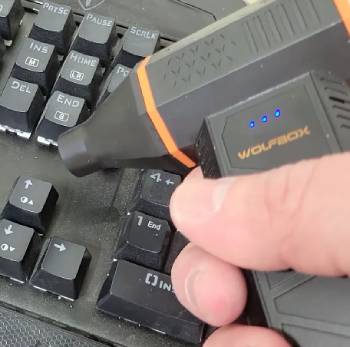
When I used it to clear a mechanical keyboard, the lack of weight meant I could manipulate it at awkward angles without any hand fatigue.
The 110,000 RPM output easily handled loose grit, cat hair on my workspace desk, and the lint buildup inside my phone’s charging port.
The four included nozzles twist and lock firmly into place. The narrowest nozzle concentrates the airflow perfectly for deep-set dust behind desktop monitor bezels.
However, you will notice its limitations when facing sticky or packed debris. For example, when trying to blow out the fine silt that collects at the bottom of car cup holders, the MF50 required multiple passes and a bit of physical agitating to lift the dirt.
It is a highly portable, approachable maintenance tool that excels at preventing dust accumulation.
Wolfbox MF50 Pros and Cons
Pros:
- Exceptionally lightweight body at just 0.45 lb, preventing user wrist strain during extended cleaning sessions.
- Outstanding battery performance yielding up to 240 minutes of continuous runtime on the lower gear.
- Versatile 4-nozzle kit that manages standard electronics maintenance and quick home dusting tasks safely.
- Highly cost-efficient entry point for users looking to permanently replace expensive single-use aerosol cans.
Cons:
- Extended 3.5-hour charging cycle can feel slow when you need to jump right back into a big project.
- May struggle with heavy, impacted debris or wet dust accumulation inside demanding outdoor mechanical environments.
Real User Experiences with the Wolfbox MF100
Switching to the MF100 introduces an immediate upgrade in build quality. The body features an all-metal chassis that feels substantial and cool to the touch.
Weighing 0.66 pounds, it has a solid, premium weight that communicates durability. It feels like a professional grade tool designed to withstand drops inside a workshop or garage.
The cleaning performance on electronics is spectacular. When blowing out a dusty gaming PC case, the 45 m/s air stream instantly stripped away the gray dust mats blanketing the graphics card backplate and the CPU heatsink fins. It didn’t just move the dust around; it forcefully ejected it out the back of the case.
The accessory package adds immense practical value. You get 5 distinct nozzles alongside 2 specialized cleaning brushes.
The brushes let you break the static bond of stubborn dust films on fans before blasting them away with the air stream.
The primary downside is the rapid battery drain on maximum speed; if you leave it pinned on the highest gear, the unit gets warm and the battery usage drops significantly, making it better suited for focused, high-intensity bursts.
Wolfbox MF100 Pros and Cons

Pros:
- High-performance 150,000 RPM brushless motor generating an elite 45 m/s wind speed for tough jobs.
- Premium all-metal construction provides excellent physical durability and high structural integrity.
- Comprehensive 7-piece accessory kit featuring specialized static-safe brushes and high-pressure detailing nozzles.
- Accelerated 2.5-hour quick-charge capability minimises downtime between cleaning intervals.
Cons:
- Shorter overall battery runtime of 100 minutes on low gear due to the power demands of the larger motor.
- Noticeably higher acoustic output and high-pitched whine when operating at full mechanical capacity.
Practical Applications in Electronics and PC Maintenance
For tech enthusiasts, choosing between these two blowers comes down to how frequently you clean your equipment and the complexity of your builds.
If your routine involves a quick weekly blow-out of your laptop keyboard and desk surface, the MF50 is an exceptional companion.
Its air pressure is safe around delicate ribbon cables and internal components, reducing the risk of accidentally dislodging sensitive parts.
If you deal with high-end desktop towers, open-loop liquid cooling loops, or server racks, the MF100 is almost mandatory.
Dust settles deep within the cooling channels of radiator fins, and the MF50 often lacks the raw pressure needed to push that dirt all the way through. The MF100 clears these obstructions effortlessly.
When working inside a computer case, remember to secure your cooling fans.
The high-speed airflow from either device can spin an unsecured fan far past its rated RPM, potentially damaging the bearing or generating a reverse current back into your motherboard headers.
Hold the fan blades steady with a finger or a small piece of tape, then use short bursts of air to clean the blades.
Also Read: My Thoughts On Jazz Total Detox Drink
Automotive Detailing and Everyday Home Utility
Outside the office, both tools prove surprisingly versatile in a vehicle interior. Car dashboards, HVAC vents, and center consoles are notorious for collecting dust in crevices where microfiber cloths cannot reach.
The MF50 is great to keep in the glove box for quick traffic-light cleanups, using its long battery life to keep the cabin surfaces clean over several weeks.
The MF100 serves as a true detailing tool. Its high wind velocity makes it ideal for clearing out crumbs from deep within seat seams, blowing water out of exterior door mirrors after a wash, or cleaning out tight engine bay channels.
The added brushes help agitate dry mud on the floor mats before you lift it out with the air blast.
Around the house, these blowers quickly replace traditional dusters. You can use them to clear out window tracks, remove lint from vacuum filters, or clean the delicate cooling coils behind your refrigerator.
The MF100 can even pull double duty outdoors, acting as a quick campfire starter or an inflator for camping mattresses and pool floats thanks to its high-volume utility nozzles.
Device Maintenance and Longevity Tips
To ensure your electric air duster maintains peak pressure and lasts for years, you should implement a simple care routine.
The air intake vents, typically located at the bottom of the handle, must always remain completely unobstructed during operation.
If your hand blocks these vents, the motor will quickly overheat, triggering its thermal protection or shortening the lifespan of the brushless bearings.
Periodically check the intake mesh for lint or hair accumulation. A blocked intake starves the turbine of air, reducing the output velocity and causing the battery to drain faster as the system works harder. Clean the mesh using a soft brush or a light wipe.
Store your duster in a temperature-controlled environment rather than leaving it in a freezing garage or a hot car trunk for months.
Extreme temperatures degrade the internal lithium-ion cells over time, permanently shrinking your maximum runtime. Try to store the battery with a partial charge if you plan to leave it unused for an extended period.
Also Read: Comparison Of Miele CX1 Vs. C3: A Tale Of Two Vacuum Cleaners
Frequently Asked Questions (FAQs)
The MF50 is generally safer for external camera bodies due to its gentler airflow, but when cleaning internal sensors, you should use the MF100 on its lowest setting from a safe distance to avoid any direct static or pressure damage.
Yes, both units offer consistent, multi-use pressure that completely eliminates the need for disposable cans, saving you money while protecting the environment from chemical propellants.
The MF50 remains cool during standard operation, whereas the high-powered MF100 can become warm near the motor housing when run continuously on its highest gear for several minutes.
Yes, both models include specialized wide-cone nozzles that allow them to rapidly inflate high-volume low-pressure items like camp beds and beach balls.
No, both the MF50 and MF100 feature integrated internal lithium-ion batteries that are charged via USB-C and cannot be swapped out by the user.
Final Thoughts
Your final decision should hinge on whether you need a lightweight, long-running maintenance companion or a high-velocity, rugged cleaning tool.
The Wolfbox MF50 is the master of daily upkeep, offering an incredibly light chassis and massive battery endurance that makes it easy to grab for quick household chores.
It represents a fantastic, budget-friendly entry into cordless blowing technology.
If you demand absolute performance, the Wolfbox MF100 stands out as the superior choice.
Its 150,000 RPM motor, rugged all-metal body, and extensive brush kit allow it to tackle heavy, deep-set messes that leave smaller dusters spinning their wheels.
By understanding the balance between the MF50’s exceptional battery longevity and the MF100’s uncompromising raw power, you can confidently select the exact tool that will keep your workspace and gear perfectly clean.