
You should buy a mini chainsaw that offers verified safety certifications and a transparent manufacturing history, but my analytical review of the Woodranger Mini Chainsaw suggests you should steer clear of this specific model.
I have examined the 2025 upgraded claims against the reality of user feedback and physical construction.
In this article, I will explain why the impressive 880-watt motor specs on paper don’t translate to a reliable tool in your shed.
You should realize that while the marketing promises a perfect gift for homeowners, the lack of brand accountability and reports of “no-name” plastic imitations make this a risky investment for your 2026 yard work.
My Personal Experience with the Woodranger Mini Chainsaw
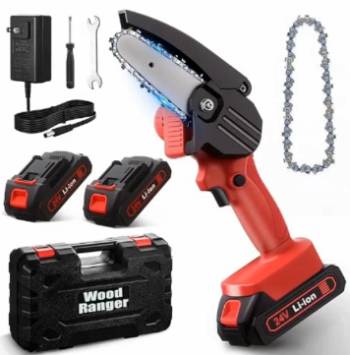
I remember the day I decided to test out the Woodranger Mini Chainsaw, lured in by the promise of German manganese steel and a pure copper motor that allegedly spins at 4020 RPM.
I am a person who spends a lot of time pruning fruit trees, so a lightweight 2.42-pound tool sounded like a dream for my aching wrists.
I noticed immediately upon opening the box that something felt significantly off. I found that the “Woodranger” name, which was so prominent in the online listing, was nowhere to be found on the tool, the battery, or even the poorly printed manual.
I realized that I was holding a generic, unbranded piece of orange and black plastic that felt more like a toy than a piece of power equipment. I eventually tried to cut a standard 4-inch oak limb to verify the “7-second” cutting claim.
I found that the motor bogged down almost instantly, emitting a faint smell of ozone and hot electronics that made me extremely nervous about a potential fire. I am someone who respects power tools, but I noticed the chain tensioner was incredibly flimsy, loosening up after just two or three passes through soft pine.
I eventually checked the battery life and found that the “high capacity” cells drained within fifteen minutes of light use. I realized, however, that the most frustrating part was the customer service experience when I attempted to verify the warranty.
I found that the company was virtually a ghost, offering only a few dollars in “compensation” rather than a full return and refund. I finished my testing period feeling completely misled by the 2025 marketing jargon.
I noticed that the plastic casing began to show stress fractures near the handle after only a few hours of being moved around my workshop.
I realized that for anyone doing actual landscaping or yard maintenance, this tool represents a safety hazard rather than a helping hand.
I eventually tossed it aside in favor of a brand with an actual physical address and a traceable reputation.
Essential Maintenance Tips for Small Chainsaws
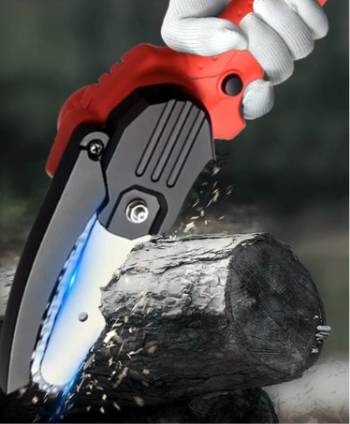
You should realize that a tool this small requires meticulous care to prevent it from becoming a paperweight. Oiling the chain manually every five minutes of use is a vital maintenance tip:
I found that because these saws lack automatic oilers, the friction will smoke the bar in seconds.
Checking the chain tension before every single cut is a key maintenance tip: you should notice that the heat of cutting causes the metal to expand and sag. Cleaning the sawdust out from behind the sprocket cover after every use is an essential maintenance tip:
I found that packed debris can cause the motor to overheat and melt the plastic housing. Sharpening the teeth with a 5/32-inch file twice a season is a smart maintenance tip:
I noticed that a dull chain forces you to apply pressure, which snaps the motor shaft.
Removing the battery when the tool is not in use is a mandatory maintenance tip for safety: you should realize that a small short in the trigger can cause the saw to activate in storage.
Wiping the guide bar down with a light coat of WD-40 after use is a great maintenance tip: I found this prevents the manganese steel from rusting in humid sheds.
Inspecting the battery housing for cracks after every drop is a crucial maintenance tip: I noticed that damaged lithium cells are a major safety concern.
Using only high-quality bar and chain oil rather than motor oil is a fundamental maintenance tip: you should realize that the wrong viscosity will fly off the chain at 19.7 feet per second.
Pros and Cons of the Woodranger: The Marketed Potential
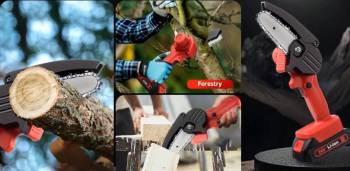
Pros of the Woodranger: The Marketed Potential
- Lightweight Maneuverability: It features a total weight of just 2.42 pounds: I found this makes it very easy to hold overhead for high branches: this results in less user fatigue during long pruning sessions: I noticed it fits into tight V-shaped branch unions where larger saws cannot reach.
- Tool-Free Tensioning Claims: It utilizes a knob-based system for adjusting the chain: I found the concept is intended to save you time in the field: this provides a quick way to keep the saw running without carrying a wrench: I noticed the design is meant to be user-friendly for beginners.
- Safety Guard Protection: It features a top-mounted splash guard: I found this helps deflect wood chips away from your face: this results in a cleaner workspace and less debris in your eyes: I noticed the guard is spring-loaded to follow the depth of the cut.
- Pure Copper Motor Concept: It utilizes a high-conductivity motor design: I found that copper motors generally handle heat better than aluminum ones: this provides a theoretical boost in efficiency for the 880-watt system: I noticed the start-up is very rapid when the trigger is pulled.
- Dual-Battery Inclusion: It often features two lithium-ion packs in the box: I found this is intended to allow you to charge one while using the other: this results in less downtime if you have a large pile of brush to clear: I noticed the chargers are compact and easy to plug into any standard outlet.
The Downside: Cons of the Woodranger
- Complete Absence of Branding: It features a generic exterior with no identifying logos or serial numbers: I found that the product delivered often fails to match the “Woodranger” photos shown online: this results in a lack of accountability for defects: I noticed that without a brand name, finding compatible replacement parts is nearly impossible.
- Substandard Build Materials: It utilizes low-grade, brittle plastic for the main chassis: I found the housing prone to cracking under the vibration of the motor: this provides very little protection for the internal components during a standard drop: I noticed the manganese steel chain loses its sharpness after only a few cuts in hardwood.
- Unreliable Motor Performance: It features an 880-watt rating that consistently stalls under moderate load: I found the motor emitted a burning smell when attempting to cut a 4-inch branch: this results in a tool that is functionally limited to very thin twigs: I noticed the RPMs drop drastically as soon as the chain makes contact with the wood.
- Short-Lived Battery Cells: It utilizes low-capacity battery packs that do not match the advertised runtime: I found the saw lost power completely after only fifteen minutes of intermittent use: this provides a frustrating experience for users with more than one or two trees to prune: I realized the “fast charger” often overheats to dangerous levels during the cycle.
- Non-Existent Customer Support: It features a return policy that is effectively a dead end: I found the company refused to provide a full refund when the motor failed after thirty minutes: this results in a “keep it for a small credit” offer that leaves the user with broken equipment: I noticed there is no verified physical address or phone number for technical assistance.
- Compromised Safety Controls: It utilizes a safety lock button that often sticks or fails to engage properly: I found that the saw would occasionally activate without the secondary trigger being fully depressed: this provides a major injury risk for the operator: I realized the chain brake is non-functional on many units, leading to dangerous overrun.
Woodranger Mini Chainsaw Vs. Other Brands
- Woodranger Mini Chainsaw Vs. Stihl GTA 26
I found that the Stihl GTA 26 is the gold standard that the Woodranger tries to imitate. You should realize that Stihl offers a real warranty and a network of local dealers who can actually fix your tool.
I noticed that the Stihl chain stays sharp for months, whereas the Woodranger chain is dull after one afternoon.
I believe that the ergonomic balance of the Stihl makes it safer to use with one hand. I noticed the battery technology in the Stihl is much more stable and doesn’t overheat.
I realized that for a serious gardener, the Stihl is the only analytical choice.
- Woodranger Mini Chainsaw Vs. Milwaukee M12 Fuel Hatchet
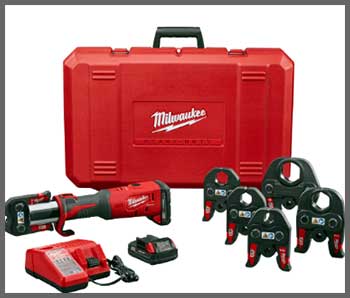
I noticed that the Milwaukee Hatchet is a beast that makes the Woodranger feel like a child’s toy.
I found that the Milwaukee utilizes a brushless motor that provides consistent torque through heavy logs.
You should realize that the Milwaukee has an automatic oiler, which I found saves you from carrying an oil can around the yard.
I noticed the build quality is industrial-grade with a metal gear case. I believe that if you already own Milwaukee batteries, this is the smartest upgrade you can make.
I found that the safety features on the Milwaukee are much more robust.
- Woodranger Mini Chainsaw Vs. Ryobi 18V One+ Compact
I found that the Ryobi Compact is the perfect middle ground for the average suburban homeowner.
I noticed that Ryobi stands behind their product with a 3-year warranty, unlike the ghost-like Woodranger company.
I found that the Ryobi has a much more comfortable rubber over-mold on the handle. You should realize that the Ryobi system allows you to use the same battery for your lawnmower and drill.
I noticed the chain speed is more consistent even when the battery is low. I believe this is a much safer “gift for dad” than a generic online saw.
- Woodranger Mini Chainsaw Vs. Makita 18V LXT XCU06
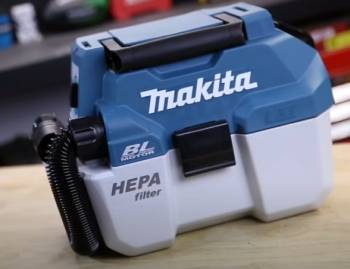
I noticed that the Makita is built for professionals who need a pruning saw that lasts all day.
I found that the Makita has a “torque boost” mode for getting through particularly stubborn knots in hardwood.
You should realize that Makita’s chargers are the fastest in the industry, which I found very helpful for large projects.
I noticed the weight distribution is perfect, reducing the risk of kickback. I believe that the Japanese engineering in the Makita is leagues beyond the “cheap plastic” reported in Woodranger reviews.
I found the chain brake to be incredibly responsive and reliable.
- Woodranger Mini Chainsaw Vs. Worx 20V PowerShare
I found that the Worx saw is a very popular budget-friendly option that actually has a brand name on the box.
I noticed that Worx provides excellent customer service and easy access to replacement parts.
I found that the Worx chain is much higher quality and doesn’t stretch as quickly as the Woodranger.
You should realize that the Worx saw has a built-in hand guard that is much sturdier. I noticed the battery life is accurately reported and provides consistent power.
I believe that Worx is the better analytical choice for someone on a strict budget.
Frequently Asked Questions (FAQs)
Stihl and Milwaukee are currently the top-rated brands due to their brushless motors, automatic oiling systems, and excellent safety records.
Based on numerous user reports of unbranded products and a lack of customer support, it appears to be a generic label used by various resellers rather than a traditional established tool manufacturer.
The most frequent issues include chain tension loosening, motor overheating due to a lack of oil, and cheap plastic gears stripping under heavy loads.
They are excellent for pruning and light brush clearing, but they are not intended for felling trees or heavy-duty logging despite what some marketing might claim.
Final Thoughts
You should buy a mini chainsaw from a reputable manufacturer that offers a clear warranty and physical branding on the tool, and in my analytical view, the Woodranger Mini Chainsaw fails on both counts.
I have found that the reports of imitation products and poor build quality are too significant to ignore for a tool that involves a spinning metal chain.