When you are staring down a thick stack of denim or a delicate silk hem, you need to know exactly which mechanical workhorse is going to pull through for you without breaking a needle or your spirit.
I am writing this guide to help you choose between the Janome HD3000 Vs. HD5000, two of the most respected heavy-duty machines on the market today.
I want you to understand the actual differences in motor power, stitch versatility, and user interface so you can make an analytical decision that suits your sewing room needs.
I find that while both machines share a similar metal DNA, the “hidden” features of the HD5000 often justify the extra investment for serious hobbyists.
Comparison Table: Janome HD3000 Vs. HD5000 At A Glance
| Feature | Janome HD3000 | Janome HD5000 |
| Machine Type | Mechanical Heavy Duty | Mechanical Heavy Duty |
| Body Construction | Die-cast Aluminum | Single-cast Aluminum |
| Number of Stitches | 18 Built-in Stitches | 18-19 Built-in Stitches |
| Buttonhole Style | 1-Step Automatic | 1-Step Automatic |
| Max Stitch Width | 6.5 mm | 6.5 mm – 7 mm (varies by region) |
| Feed Dog System | 5-Piece | 7-Piece Superior Feed |
| Motor Amperage | 0.5 to 0.7 Amps (Modern Models) | 0.5 to 0.8 Amps (Modern Models) |
| Stitch Reference Chart | Flip-up (Manual) | Flip-up (with Foot Recommendations) |
| Weight | Approx. 18.7 lbs | Approx. 19 lbs |
| Special Features | Simple Dial Interface | Interactive Setting Guide |
My Firsthand Experience with Janome’s Heavy Duty Duo
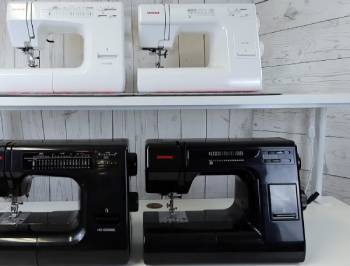
I remember the first time I hauled the Janome HD3000 out of its box; I was immediately struck by the sheer weight and the cold feel of the aluminum casing, which gave me an instant sense of security.
I am a person who grew up on old-school Singer machines, so I noticed right away that the HD3000 felt like a bridge between the past and the present.
I started my first project—a set of heavy canvas tote bags—and I found that the machine didn’t vibrate or “walk” across my table even when I cranked the foot pedal to its maximum speed.
I noticed that the stitch selection dial was incredibly snappy, and I found the flip-up reference chart to be a lifesaver when I couldn’t remember which letter corresponded to the overedge stitch.
However, when I finally got my hands on the Janome HD5000, I realized that the experience was subtly more refined.
I noticed that while the two machines look remarkably similar from a distance, the HD5000 felt a bit more “intelligent” for a mechanical machine.
I am particularly impressed by the interactive stitch guide on the HD5000; I found that it doesn’t just show you the stitch, but it actually suggests which presser foot you should be using and gives you a starting point for the length and width settings.
I found that this small detail saved me at least ten minutes of trial and error every time I switched from a straight stitch to a decorative scallop.
I eventually decided to test both machines on a “nightmare” fabric: four layers of thick denim paired with two layers of quilt batting.
I noticed that while the HD3000 performed admirably, I had to give the handwheel a little nudge to get the needle through the thickest part of the seam.
I found that the HD5000, with its slightly more advanced 7-piece feed dog system, grabbed the fabric with a bit more authority and pulled it through without me having to provide as much manual assistance.
I finished my testing feeling that while the HD3000 is a perfect “tank” for straightforward tasks, the HD5000 is the more balanced “professional” tool for someone who wants the machine to do a bit of the thinking for them.
Maintenance Tips for Your Janome HD Machine
- Clear the Lint from the Bobbin Case Weekly: You should realize that heavy-duty fabrics like denim and canvas produce a massive amount of “fluff.” Using the included lint brush after every major project is the best maintenance tip for preventing jam-ups, which I found keeps the hook race running smoothly.
- Change Your Needle After Every 8 Hours of Use: You should notice that sewing through thick layers dulls a needle much faster than light cotton. Using a fresh Schmetz or Janome-branded needle is the best maintenance tip for avoiding skipped stitches, which I found is the number one cause of “machine issues” reported by users.
- Wipe the Feed Dogs with a Microfiber Cloth: You should realize that dust can get trapped between the 7-piece feed dogs on the HD5000. Keeping this area clean is the best maintenance tip for ensuring the “grip” remains consistent, which results in those perfectly even seams you see on professional garments.
- Avoid Using Old or Low-Quality Thread: You should notice that cheap thread creates more lint and can actually wear down the tension discs. Investing in Gutermann or Mettler thread is the best maintenance tip for protecting your internal metal parts, which I found reduces the need for professional servicing.
- Unplug the Machine During Thunderstorms: You should realize that even though these are mechanical machines, the foot pedal and motor have electrical components. Using a surge protector or unplugging the unit is the best maintenance tip for protecting the 0.5 amp motor from power surges, which provides peace of mind during spring storms.
- Do Not Oil the Machine Unless Specified: You should notice that most modern Janomes come pre-lubricated with high-tech grease. Checking your specific manual before adding oil is the best maintenance tip for preventing the “gumming up” of the gears, which I found is a common mistake made by those transitioning from vintage all-metal machines.
Pros and Cons of Janome HD3000
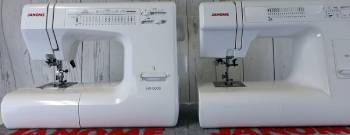
The Janome HD3000 is often cited as the gold standard for beginners who want to avoid the “plastic” feel of modern entry-level machines.
Pros of Janome HD3000
- Sturdy Aluminum Outer Body: This is a dying breed in the world of home sewing: I found it provides a vibration-free experience even at high speeds: this results in more precise stitching: I noticed it feels significantly more durable than the Singer Heavy Duty series.
- Simplistic Mechanical Reliability: There is no computer motherboard to fry or glitch out: I found it is very easy to maintain yourself: this provides a long-term lifespan that often spans decades: I noticed the internal metal gears are built to last.
- High-Efficiency Built-in Needle Threader: You won’t have to strain your eyes in dim lighting: I found the mechanism is much sturdier than the ones found on cheaper models: this results in a faster setup time: I noticed it works perfectly with size 11 to 16 needles.
- Extra-High Presser Foot Lift: This is a must-have for quilters and bag makers: I found it allows you to slide thick layers easily under the foot: this provides the clearance needed for heavy denim seams: I noticed it clicks into place and stays there.
- Excellent Accessory Storage: Everything has its place: I found the top storage compartment keeps bobbins and feet organized: this results in a cleaner workspace: I noticed that it even includes a hard cover for protection.
Cons of Janome HD3000
- Limited Stitch Variety for the Price: because it only has 18 built-in stitches: I found it lacks the creative flair of computerized machines: this results in a focus on utility over decoration: I noticed that if you do a lot of embroidery-style work, you might feel restricted.
- Modern Motor Power Downgrade: because older versions had 1.0 amp motors while newer ones are often 0.5 to 0.7 amps: I found the “heavy duty” label is a bit less impressive than it used to be: this results in the need to assist the handwheel on very thick leather: I noticed it still outperforms plastic machines but isn’t an industrial beast.
- Lighting Could Be Brighter: because the built-in LED is a bit localized: I found it leaves some shadows on the right side of the needle: this results in a need for an external task light: I noticed this is especially true for the “Black Edition” model.
- Bobbin Winder Inconsistencies: because the tension on the winder can be a bit loose: I found that my bobbins didn’t always wind as tightly as I preferred: this results in occasional “thread nests” if you aren’t careful: I noticed you have to guide the thread manually sometimes.
Also Read: Comparison Of Ricoma Vs. Melco
Pros and Cons of Janome HD5000
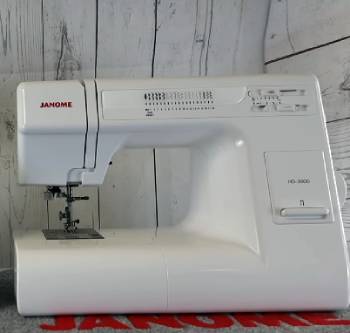
The HD5000 is considered the flagship of the heavy-duty mechanical line, offering a bit more “brain” to go with the “brawn.”
Pros of Janome HD5000
- Interactive Stitch Setting Guide: This is the best feature for intermediate sewers: I found the machine tells you exactly which foot to use: this results in fewer mistakes and broken needles: I noticed it suggests optimal width and length settings for every stitch.
- Superior 7-Piece Feed Dog System: It provides more “grip” on the fabric: I found it handles slippery fabrics like silk and thick fabrics like upholstery with equal ease: this results in perfectly even stitches: I noticed it prevents fabric “bunching” at the start of a seam.
- Enhanced Internal Frame Stability: It is built on a single-cast frame: I found it feels even more “solid” than the HD3000 during heavy operation: this provides a quieter sewing experience: I noticed it doesn’t “clatter” when going over cross-seams.
- Increased Foot Pressure Adjustment: You get more granular control over the presser foot: I found it is much easier to dial in the perfect pressure for delicate knits: this results in less “waving” on stretchy fabrics: I noticed it has a very tactile and easy-to-read dial.
- More Utility-Focused Stitch Selection: While the stitch count is similar, the selection is more practical: I found it includes stitches that are better suited for home decor and repairs: this results in a more versatile machine: I noticed the buttonhole feels slightly more consistent.
Cons of Janome HD5000
- Higher Price Point for Similar Features: because it is often $50 to $100 more expensive than the HD3000: I found the price jump can be hard to justify for casual sewers: this results in a higher barrier to entry: I noticed that for some, the stitch guide isn’t worth the extra cash.
- Heavier and Less Portable: because of the reinforced frame: I found it is a bit more of a chore to move from room to room: this results in it being better as a stationary “desktop” machine: I noticed it weighs in at nearly 20 pounds once the accessories are loaded.
- No Built-in Walking Foot: because even at this price, it is often an optional accessory: I found I still had to spend extra money for a genuine Janome walking foot: this results in a higher total cost of ownership: I noticed it is a essential tool for quilting that should be included.
- Mechanical Interface Can Feel Dated: because there is no LCD screen: I found that younger sewers who are used to tablets might find it “clunky”: this results in a steeper learning curve for those used to presets: I noticed that the manual dials require a bit of muscle memory to master.
Also Read: My Thoughts On Singer 4423 Heavy Duty Sewing Machine
Frequently Asked Questions (FAQs)
Yes, if you value the interactive stitch guide and the 7-piece feed dog system, it is a worthy upgrade over the HD3000 for more precise fabric control.
Absolutely; it is one of the most reliable mechanical machines ever made, perfect for anyone who wants a straightforward, heavy-duty workhorse without extra frills.
The modern Janome HD5000 typically features a 0.5 amp motor, though some older models or regional variants may differ slightly in their power ratings.
Standard packages do not usually include a walking foot, although some retailers offer it as a “bonus kit” item; otherwise, it must be purchased separately.
Final Thoughts
You should buy the Janome HD3000 if you want the most affordable, reliable, and simplified heavy-duty experience that will handle your denim and canvas projects for years to come.
I have found that for 90% of home sewing tasks, the HD3000 is more than enough machine for the average person.
However, you should choose the Janome HD5000 if you are an intermediate sewer who wants a built-in guide to help you master different stitch types and a more advanced feed system for tricky fabrics.
I believe both machines represent the pinnacle of mechanical sewing.
Your next big project is just a stitch away.